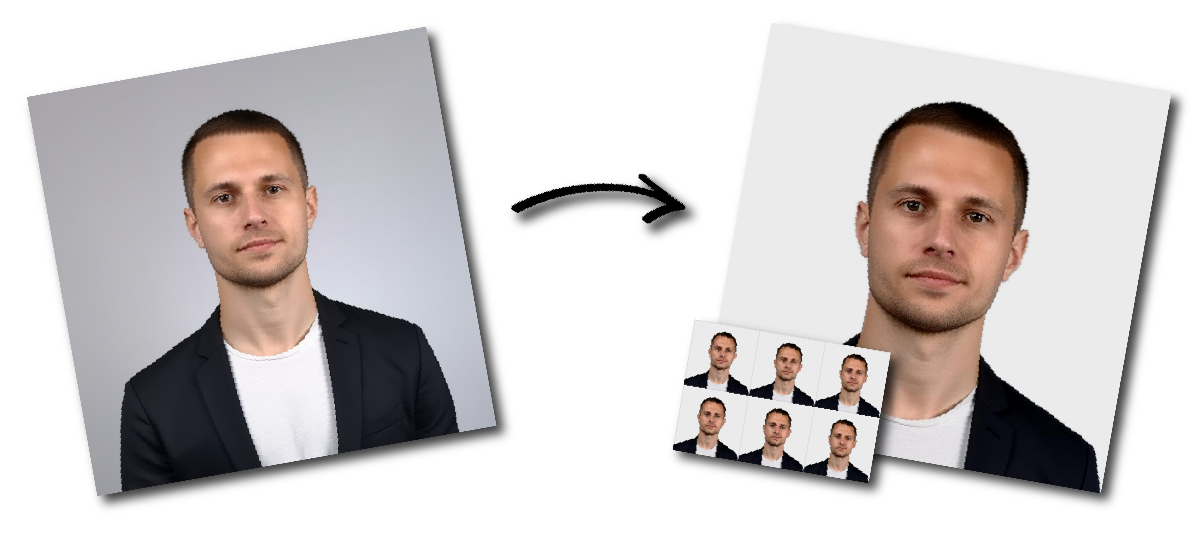

Don't worry about the size requirements. Our tool will automatically create correct United Kingdom Driving Licence photos for you.
Printed Driving Licence Photo Size
A printed UK driving licence photo should follow the standard passport-style format:
Photo dimensions: 45 mm high × 35 mm wide
Head height: 29–34 mm from the crown of the head to the chin
Colour: Full colour
Background: Plain cream or light grey
Paper: Professional-quality white photographic paper
Border: No border
Recency: Taken within the previous month
View: Full face and upper shoulders
Expression: Plain expression with the mouth closed
Quality: Clear, sharp and undamaged
Do not cut a larger photograph down manually to reach 35 × 45 mm. Use an image prepared and printed at the correct dimensions.
When using an online DVLA service, you may be able to use your current UK passport photograph or upload a new image.
The online service will check the photograph during the application process. Follow the size, format and file-quality instructions displayed by DVLA when uploading the file.
A suitable source image should:
Be recent and clearly show your current appearance
Be in colour
Be sharp and in focus
Show your head, shoulders and upper body
Have a plain, light-coloured background
Show you looking directly at the camera
Contain no other people or objects
Contain no shadows covering your face
Be free from red-eye
Be unaltered in a way that changes your appearance
You may need a new photo when:
Applying for your first provisional driving licence
Renewing an expiring photocard licence
Updating the photograph on your current licence
Replacing an older paper licence with a photocard
Exchanging another driving licence where a photograph is requested
Your appearance has changed significantly
The online process may ask you to confirm your identity using a passport, driving licence or another accepted identity method. You may be offered the option to use your passport photograph or provide a new digital image.
Follow the application screens rather than preparing a printed photograph unless the service specifically asks you to send one.
A postal application or renewal normally requires a recent printed passport-style photograph.
Face the camera directly and hold your head upright. Keep your eyes open and clearly visible, and use a plain expression with your mouth closed.
Your photograph should show:
Your full head
Both sides of your face
Your upper shoulders
Natural skin tones
Clear contrast between you and the background
Do not tilt your head, look over your shoulder or look away from the camera.
Use a plain cream or light-grey background. There should be no patterns, furniture, visible objects or other people behind you.
Use soft and even lighting. Avoid:
Strong shadows on your face
Shadows on the wall behind you
Direct flash
Red-eye
Overexposure
Dark areas hiding facial features
Reflections from glasses
Stand some distance away from the background to reduce shadows.
Remove glasses whenever possible.
When glasses must be worn:
Your eyes must remain clearly visible
The frames must not cover your eyes
The lenses must not be tinted
There must be no glare or reflections
Do not wear sunglasses.
Hats and other head coverings are not permitted unless worn for religious or medical reasons. A permitted covering must not obscure your face.
Remove headphones, earbuds and other accessories that interfere with a clear view of your head or face.
The photograph must remain a true likeness of you.
Do not:
Apply beauty or portrait filters
Smooth the skin
Remove scars, marks or other identifying features
Reshape the face, eyes, nose or mouth
Change your hairline
Add digital makeup
Replace your face with an AI-generated image
Sharpen or enhance the image until it looks unnatural
Basic resizing and cropping may be used to prepare a printed photograph, provided they do not alter your appearance.
A background may be cleaned or adjusted only when the final image still looks natural and the applicant’s outline has not been distorted.
A photograph may be rejected or require replacement when:
It is older than one month
It is blurry, pixelated or poorly exposed
The printed image is not 45 × 35 mm
The head is too large or too small
The visible background is pure white instead of cream or light grey
The applicant is smiling, frowning or has their mouth open
The applicant is not looking directly at the camera
Hair, glasses or an accessory covers the eyes
Shadows obscure the face
Red-eye is visible
The photo contains another person or object
The image has been digitally altered
The printed photo is creased, torn or marked
A required certifying signature is missing
The digital file fails the online service’s validation
Northern Ireland driving licences are administered by the DVA rather than DVLA.
For a printed Northern Ireland application photo, the image should be:
45 mm high × 35 mm wide
Taken within the previous month
In colour
Printed to a high standard
Taken against a light-grey or cream background
A true likeness showing the applicant’s full head
Northern Ireland also accepts digital photographs or photo codes for eligible online applications.
A printed passport-style driving licence photo is 45 mm high by 35 mm wide.
For a printed passport-style image, the distance from the crown of the head to the chin should be between 29 mm and 34 mm.
No. The visible background behind the applicant should normally be plain cream or light grey. The photo itself should be printed on white photographic paper.
Yes, when the applicable online service allows you to upload a new image. Ask another person to take it where possible, use even lighting and leave enough space to include your head, shoulders and upper body.
DVLA may allow you to use the photograph associated with your valid UK passport during an online driving-licence application or renewal.
Not every applicant needs a signed photo. Certification may be required for some first postal applications, depending on how identity is proved. It is generally not required when DVLA can verify identity using a passport or share code, or when renewing with a new photo.
Use a plain, neutral expression with your mouth closed.
Remove glasses where possible. When they must be worn, your eyes must remain clearly visible and there must be no glare, tint or reflection.
Use a photograph taken within the previous month.