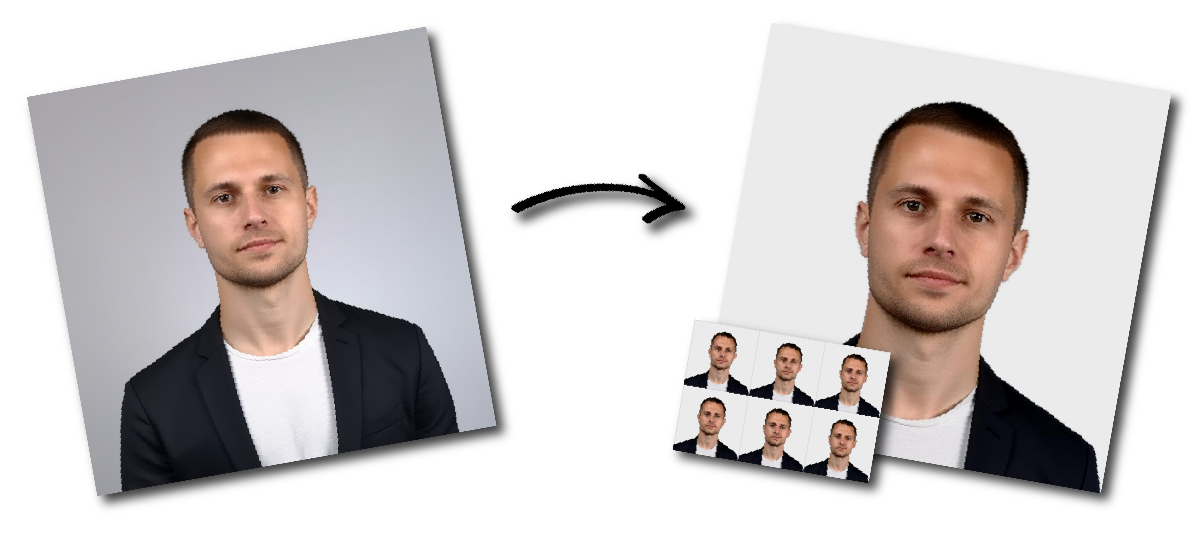
Photo Date and Condition
- The photo must have been taken within the past six months.
- It must not have any ink marks, stains, folds, creases, or borders.
Photo Size and Composition
- The photo must be a close-up image showing the applicant’s head and the top of the shoulders.
- The face should occupy about 70% to 80% of the photo.
- The applicant’s face must be centered horizontally.
Facial Expression and Head Position
- The applicant must look directly at the camera with both eyes open and clearly visible.
- The applicant must have a natural and neutral facial expression.
- The mouth must be closed, and the teeth must not be visible, unless a medical condition prevents the applicant from closing the mouth naturally.
- The head must not be tilted or turned to either side.
Face, Hair, and Ear Visibility
- The applicant’s hair must not cover the eyebrows or eyes.
- The full outline of the face must be clearly visible.
- Both sides of the face, both ears, and any distinguishing marks such as moles, birthmarks, or scars must be clearly visible and unobstructed.
- If the applicant has microtia, hair may cover the ears, but the outline of both sides of the face must still be clearly visible.
Skin Tone and Lighting
- The applicant’s skin tone must appear natural.
- The photo must have appropriate brightness and contrast.
- The lighting must be even, and there must be no shadows, glare, or uneven brightness on the face. Red-eye effects are not permitted.
Background
- The background must be plain white. It must not contain patterns, objects, shadows, or other people.
Image Quality and Printing
- The photo must be sharp, clear, and free from blur or jagged edges.
- It must be printed in high resolution on high-quality glossy photo paper.
- Photos printed with poor quality or on paper that is too thin may be rejected.
Digital Image Requirements
- The original image must not be resampled or resized before printing.
- If the photo is taken with a digital camera, the camera must have at least 3 megapixels and must be set to the highest quality and color settings.
- Digital retouching or enhancement of the image is not allowed.
Glasses and Contact Lenses
- If the applicant wears glasses, the eyes must be clearly visible and free from glare or reflections.
- Tinted glasses are not allowed, except for visually impaired applicants.
- Eyeglass frames must not cover any part of the eyes, and thick-framed glasses should not be worn.
- Colored contact lenses and cosmetic circle lenses are not permitted because they may create differences from the applicant’s actual appearance and may result in visa rejection or immigration difficulties overseas.
Clothing
- The applicant must not wear military, police, or camouflage uniforms or clothing.
Religious Head Coverings
- Applicants who wear head coverings for religious reasons may keep them on for the photo. However, all facial features must be clearly visible.
- The area from the bottom of the chin to the top of the forehead, as well as both sides of the face, must remain fully visible.
Infant and Young Child Photos
- Photos of infants or young children must show only the applicant.
- Objects or other people, such as chair backs, toys, pacifiers, another person, or the assisting photographer’s hands, must not appear in the photo.